
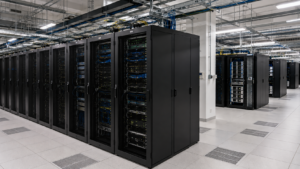
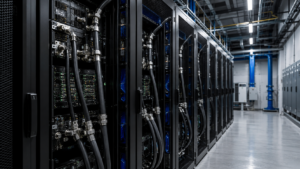
Artificial intelligence is redefining digital infrastructure throughout the U.S. Firms are pouring billions of dollars into new computing platforms. But processors alone aren’t enough to run today’s AI systems. Organizations also require networks that transport data rapidly and efficiently. Hence, AI Networking has been identified as a key imperative in the U.S. Data Center Market. Large language models, recommendation engines, and AI assistants must constantly talk to thousands of processors. This means that network decisions have a substantial impact on the performance of the infrastructure and the return on its investment. As a result, organizations are considering whether Ethernet or InfiniBand will best enable their future U.S. AI Infrastructure expansion and longer- term AI strategies.
Why the AI Boom Is Creating a New Networking Arms Race
Artificial intelligence is increasing network demands across the United States. Consequently, organizations are investing more heavily in networking infrastructure to support future AI growth.
AI Infrastructure Spending Is Expanding Beyond Compute
Companies previously concentrated their purchasing power on high-end processors. But today’s AI implementation needs more than just computing power. Companies tend to spend more on networking infrastructure. So, the AI Infrastructure Investment encompasses more than just servers and accelerators. A single, large AI system could have its processors linked together with thousands of information exchanges per training cycle. So productivity is directly affected by network performance. For instance, if a processor is waiting on data from another system, it can’t process efficiently. Consequently, a growing number of enterprises now consider networking as part of their AI Computing Infrastructure when designing for the future and upgrading infrastructure.
GPU Density Is Forcing Network Architecture Changes
Process density is still rising for organizations that want to create even more sophisticated AI. This results in a larger amount of internal traffic in the High-Density Data Centers. Traditional infrastructure design can be harder to keep up with these escalating demands. As a result, operators are re-architecting their networks around greater levels of communication. For instance, today’s GPU Clusters may have thousands of interconnected accelerators all in one environment. These two systems continuously communicate as they train sophisticated artificial intelligence models. As a consequence, network traffic is still increasing. In addition, growing organisations must plan for networking early on in their designs if they want to grow. This approach helps in future-proofing for growth and efficiency of operation.
AI Workloads Are Exposing Data Movement Bottlenecks
Contemporary AI Workloads rely on constant interaction between processors, storage systems, and the supporting infrastructure. As a result, the way information travels through networks is getting a closer look by organizations. In the past, a lot of companies catered to just processing power. However, larger AI models have exacerbated the data motion problem. For instance, large language models must have their processors repeatedly exchange data while training. As a result, delays can reduce overall productivity. Similarly, AI workloads need to be able to respond quickly during inference. Poor communication can impact how users experience an organization and its operations. As a consequence, they turned their attention to AI Networking, which later became the key enabler for the prosperous development of AI in various industries.
Networking Has Become a Competitive Differentiator
Firms are now racing to be the first to bring AI services to market. As a result, the business impact of networking extends beyond technical performance. Companies that streamline their network administration tend to run their infrastructure more efficiently. As a result, they can do more with an expensive hardware purchase. For example, processors can do useful work when they communicate efficiently. On the other hand, communication lags can have the opposite effect on productivity. This shift has fostered the inclusion of the network in the wider discussions of AI Infrastructure Strategy by organizations. And networking innovation is still riding the wave of AI Infrastructure Growth in many industries. Consequently, AI Networking is now a must-have competitive advantage in the technology industry.
The Business Case Behind Ethernet and InfiniBand Adoption
Organizations evaluate networking technologies through a business lens as well as a technical one. Therefore, networking decisions often reflect long-term operational goals, procurement strategies, and infrastructure priorities.
Why Open Ecosystems Strengthen Ethernet Adoption
Flexibility is what a lot of organizations demand when setting up AI environments. As a result, Ethernet Networking is becoming more prominent in the U.S. Data Center Industry. In contrast to the highly competitive environment, Ethernet has a vast ecosystem of vendors, hardware choices, and management software. So the organizations don’t need to rely on a single vendor when it comes to their key infrastructure elements. For instance, a business that is growing its Cloud AI Infrastructure can, in many cases, plug Ethernet into established operational environments. This minimizes complexity and facilitates future expandability and upgrades. Moreover, open standards drive industry innovation. Accordingly, many enterprises believe Ethernet will be a viable solution to long-term AI Networking infrastructure and technology modernization to be averaged over the term of the infrastructure investments.
Why Specialized AI Environments Continue to Favor InfiniBand
Optimized communication for advanced AI development is what some organizations have rather leant towards. Hence, InfiniBand Networking is still a valid and crucial choice for the tailored AI solutions. Several research organizations and AI companies rely on InfiniBand to power intensive training jobs that necessitate frequent communication between processors. For instance, entities working on foundation models regularly test out technologies that enable extreme processor coordination. As such, InfiniBand is very well adopted in niche areas in the AI community. In addition, many facilities are already deeply invested in mature InfiniBand ecosystems. Thus, they typically augment existing environments as opposed to moving to new solutions. So InfiniBand remains the platform for high-performance AI in the US.
How Procurement Strategies Influence Network Selection
Infrastructure planning now involves a greater involvement of procurement teams. As a result, network decisions are being driven more and more by broader business needs. Some organizations prefer flexibility and diversity of suppliers. Some are tied to specialized capabilities or specific workload types. For instance, firms that are building large AI deployments may assess infrastructure lifecycles when choosing technology platforms. This ensures business value from infrastructure investments over time. In addition, procurement teams evaluate support models, upgrade paths, and operational needs. Hence, the technology choice is about more than running performance comparisons. For this reason, a large number of companies are coordinating their networking decision with that of their wider AI Infrastructure Investment and future business strategy.
Infrastructure Ownership Models Are Shaping Decisions
Infrastructure ownership strongly shapes networking priorities. Hence, organizations tend to opt for technologies that fit their operational structure and management model. Large cloud providers tend to run infrastructure at very large scales. Accordingly, they judge networking according to how efficient, standardized, and consistently operational it is. Unlike organizations that are Early Adopters of AI in the Enterprise, these organizations tend to be more concerned with whether or not they can run the tools in their existing environments and whether or not they have the internal skills. AI-native companies may have different priorities depending on what they are building and how they expect to grow. There is, therefore, not a one-size-fits-all process that a supply chain can keep in all production scenarios. To that end, ownership of infrastructure continues to influence how organizations in the U.S. are approaching AI Networking and infrastructure in the long term.
What the Outcome Means for U.S. AI Infrastructure Growth
The Ethernet and InfiniBand debate extends beyond networking technology. It is influencing infrastructure investments, deployment strategies, and future AI expansion across the United States.
Hyperscaler Expansion Is Redefining Network Requirements
Leading cloud providers are still pouring investment into AI infrastructure. Networking needs are becoming more stringent as a result. Hyperscale Data Centers now harbour a new breed of complex AI systems that must reliably communicate across thousands of processors. For example, firms including Microsoft, Google, and Meta are scaling up AI capacity to meet soaring demand for generative AI services. Therefore, the design of the network has become an important topic in strategic planning. They need to make sure infrastructure can grow with the business, rather than be a bottleneck. Hence, AI Networking is a key enabler to help hyperscalers boost efficiency, sustain even bigger workloads, and maintain long-term infrastructure capabilities.
Enterprise AI Adoption Is Broadening Networking Demand
The scope of artificial intelligence is no longer limited to the big tech companies. Rather, AI has been leveraged by enterprises in healthcare, manufacturing, retail, and finance as solutions. So the rise of Enterprise AI Adoption is driving new networking demands across the market. A lot of companies apply AI tools to automate their workflows, enhance user experience, and analyze massive amounts of data. Hence, the need for dependable infrastructure is on the rise. For instance, a financial institution can use AI-driven systems to process transactions and detect fraud in real time. Networking performance has a direct impact on business results. Hence, AI Networking demand continues to grow outside of the traditional technology sectors and out of pure research environments.
Regional AI Hubs Are Building Distinct Infrastructure Models
A number of regions are becoming significant hubs for AI development. As a result, infrastructure policies tend to mirror local strengths and investment priorities. Texas AI Data Centers continue to draw great interest due to available space, burgeoning technology investment, and access to energy. But Virginia continues to be a key infrastructure market given its mature connectivity ecosystem. Other states are also ratcheting up investments in building out AI infrastructure. As a result, the future of U.S. AI Infrastructure is now being shaped by regional rivalry. Various markets are taking different attitudes to what resources and commercial opportunities exist. Hence, geographical considerations are playing a greater part in decisions related to infrastructure planning and installation.
Why the Future May Be a Multi-Network AI Ecosystem
The next era of artificial intelligence may not ride on one networking technology. Organizations might also run multiple solutions to address different needs. In some cases, the desire is for maximum flexibility and access to the entire ecosystem. Others may be more specialized with advanced capabilities for highly evolved projects. The result is that Next-Generation AI Networks may be based on multiple technologies in multi-stakeholder infrastructure contexts. For instance, a company might have one networking strategy for training and another for enterprise applications. This approach enables infrastructure teams to align technologies to specific goals. Hence, more and more organizations are turning to multi-mode solutions in order to support a wide variety of workloads and evolving business needs.
To Sum Up
The way organizations assess infrastructure investments is being transformed by artificial intelligence. Networking isn’t an afterthought anymore. But rather, it is now part and parcel of mainstream AI playbooks. Across the U.S., groups are building out infrastructure to meet demand for increasingly sophisticated AI applications. Hence, networking decisions affect the efficiency, scalability, and long-term competitiveness of the system. Ethernet and InfiniBand both have advantages in different applications. Hence, technology decisions must be mapped to business objectives and must consider future needs. With the rapid adoption of AI, AI Networking will further define infrastructure development and investment focus, and the next-generation solutions for AI Infrastructure Strategy across the United States.
To explore the latest developments in AI infrastructure, power, cooling, networking, & high-density computing, industry leaders will gather at the 8th High-Density AI Data Center Summit 2026. It takes place on 18–19 August 2026 in Dallas, Texas.