
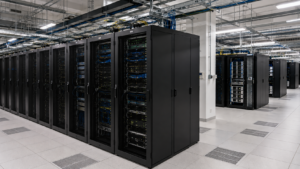
An AI rack alone could soon use as much energy as a small factory. That reality is coming a lot sooner than the semiconductor industry thought. NVIDIA’s new AI systems are taking rack power density to levels that traditional datacenters were never intended to accommodate. At the same time, cooling systems, electrical infrastructure, water networks, and utility grids are being stretched to their limits by hyperscale AI growth. The 1-Megawatt AI rack is no longer a futuristic idea talked about in engineering labs. It is rapidly becoming the next bottleneck for advancing AI infrastructure in the US. The first companies to capitalize on these changes will ultimately shape the next era of AI leadership.
The 1-Megawatt AI Rack Is Breaking Traditional Datacenter Physics
AI infrastructure now faces constraints that traditional datacenter models never needed to solve. Electrical delivery, thermal transfer, structural loading, & network synchronization are all colliding inside the same physical environment.
Copper Resistance Is Becoming a Hidden Limitation Inside High-Density AI Systems
Most talk about the 1-Megawatt AI rack revolves around processors and coolers. But copper conductivity is becoming the greatest engineering challenge inside tightly packed AI clusters. Increased power density per rack compels the electrical systems to deliver massive current loads over decreasing distances. As a result, the resistance loss increases dramatically when the current increases.
Busbars, connectors, and internal distribution channels are being redesigned by engineers to mitigate voltage instability during the training process in the AI. At the same time, hotter conductors add to the thermal stress in already heavily-packed enclosures. Conventional datacenter power distribution afforded much less efficiency at much lower load levels. Now, the limitations of electrical materials are beginning to constrain the scale of advanced AI infrastructure in future-generation AI deployments.
AI Server Cooling Is Moving Closer to the Processor Surface
Air cooling degrades quickly after the processor generates most of its heat output in a small area of the chip beyond normal operating levels. Operators, however, are swapping the air-heavy systems for direct-to-chip liquid cooling solutions. Such systems circulate coolant across cold plates located at the top of high-output processors.
This means that a facility can extract heat prior to the Thermal spreading across the rack. Fan dependency is also heavily reduced by this technique. Meanwhile, at least one semiconductor cooling system now relies on rear-door heat exchangers to capture waste heat before it is sent into facility air systems. The 1-Megawatt AI rack is increasingly reliant on thermal transfer precision over airflow volume. That dynamic is dramatically transforming the economics of AI server cooling in today’s data centers.
Structural Engineers Are Redesigning Datacenters Around Rack Mass
The physical size and weight of next-generation AI systems are now becoming an extreme challenge for data center design. Liquid cooling manifolds, higher processor density, bolstered power supplies, and integrated networking equipment significantly add to rack weight. Therefore, the structural engineers are forced to redesign the flooring systems to allow for loads that can be sustained outdoors during the long operational periods.
Some are also adjusting seismic stabilization techniques due to the heavier AI systems inducing more motion sensitivity. Transport logistics are meanwhile complicated by the increasing size and weight of preconfigured racks. Conventional datacenters maxed out on square footage. However, the 1-Megawatt AI rack is compelling operators to use specially engineered designs for very high-density infrastructure deployment.
Dense AI Clusters Are Creating Internal Network Congestion
Training efficiency for AI now depends greatly on how fast processors can talk to each other. Dense GPU environments are becoming the source of severe latency and bandwidth issues in modern data centers. The 1 MW AI rack compounds the problem because the high density of accelerators continuously exchanges massive quantities of data in training large models. So engineers are taking interconnect distances down to a minimum and squeezing the synchronization between GPUs and memory systems.
At the same time, one of the fastest rising photonic networking platforms is emerging as electrical interconnects flounder at the end of bandwidth. This transformation is transforming the design of high-end AI infrastructure. Future AI performance could be as dependent on internal network efficiency as on the speeds of its processors.
America’s Biggest AI Challenge May Be Deployment Speed, Not Innovation
The United States still leads in semiconductor design, AI software, & hyperscale computing investment. However, infrastructure deployment timelines are now expanding more slowly than AI hardware advancement cycles.
Utility Approval Queues Are Delaying AI Datacenter Power Expansion
Many AI providers are able to get hold of the capacity of GPUs at a much faster rate than that of power today. Utility interconnection queues in several US regions now span years as grid operators are hearing simultaneous demand surges from semiconductor fabs, EV infrastructure, and hyperscale AI facilities. As a result, access to transmission capacity near strategic technology corridors is becoming the subject of growing competition and higher prices for developers.
The 1-Megawatt AI rack compounds this pressure, since facilities must make massive electrical commitments before construction even starts. At the same time, utility planning cycles continue to be based on older assumptions about industrial demand. This discrepancy is rippling out as a major hurdle for AI datacenter power scale-out. Infrastructure readiness is now almost as important for the speed of AI deployment as semiconductor innovation itself.
Modular Construction Is Compressing Semiconductor Deployment Timelines
Conventional construction techniques simply cannot keep up with the demands of today’s AI infrastructure. Hence, the semiconductor providers are turning to modular construction solutions that enable wafer fab deployment on a large scale. Prefab electrical rooms, cooling units, and mechanical utility modules are now delivered to the field either fully or partially integrated. Contractors can significantly reduce the time level of complexity involved in installing and deploying the solution as a result.
It also enhances synergy among the engineering and construction teams on multi-site expansion projects. The 1-Megawatt AI rack will probably make this transition happen even faster, as complicated infrastructure means every stage of deployment must be integrated more tightly. Smart fab development methodologies already incorporate modular design, parallel workflows, and scalable infrastructure alignment.
Water Recycling Systems Are Becoming Critical for Semiconductor Cooling
High-density liquid cooling hardware now requires sophisticated water management products in addition to a reliable power supply. As a result, operators are pouring money into closed-loop recycling systems that lessen dependence on fresh water at AI campuses. Ultra-pure water standards must also be maintained, as contaminated coolant can damage processors and heat transfer systems not only quickly, but also severely.
Meanwhile, water stress is happening across a number of regions where semiconductor factories in the U.S. still operate. It is a long-term sustainability issue for growth. The 1-Megawatt AI rack compounds these challenges because larger cooling systems move substantially more fluid continuously, the research says. Semiconductor cooling solutions are now as reliant on water purification strategy as they are thermal engineering know-how.
Advanced AI Infrastructure Is Starting to Resemble Industrial Energy Development
Large AI campuses are demanding infrastructure planning historically associated with utility-scale industrial development. Operators are now assessing microgrids, onsite backup generation, renewable integration, and longer-term energy procurement options as part of initial development. Some sites, meanwhile, are pursuing small modular reactor partnerships to meet future AI datacenter power needs reliably.
The 1-Megawatt AI rack reinforces this trend since the risk of downtime exponentially increases at ultra-density. Stronger redundancy designs are also necessary for facilities to ensure continued operation in the event of grid disturbances. As a result, the new breed of advanced AI infrastructure is becoming a long-term energy planning problem as opposed to a standard datacenter growth process.
The Companies That Master Infrastructure Density Could Control the Next AI Cycle
The next AI leaders may emerge from infrastructure execution rather than processor design alone. Deployment efficiency, operational reliability, & infrastructure coordination now directly affect AI scalability across the semiconductor industry.
Advanced Packaging Is Intensifying Thermal Concentration Inside AI Hardware
Advanced packaging technologies are significantly intensifying localized heat within AI systems. HBM stacks, CoWoS integration, and chiplet architectures all enable greater compute capacity within smaller physical footprints. As a result, thermal hotspots are becoming increasingly difficult to control at the processor-package level. The 1-megawatt AI rack exacerbates the problem because tightly integrated accelerators produce focused heat in very dense formations.
So instead of designing semiconductor cooling for air flow in the facility, they have to design it around localized thermal transfer. In the meantime, the packaging density is still increasing at a pace that the conventional cooling solution is hard to catch. This type of trend is making advanced packaging one of the best levers with which to influence rack power density moving forward.
Digital Twins Are Becoming Operational Control Systems for AI Facilities
AI facilities are becoming too complicated to be monitored by static systems. So, hardworking operators are running digital twins that move in lockstep with the infrastructure. They monitor thermal conditions, electrical load, airflow efficiency, equipment aging, and cooling effectiveness all at once. As a result, they can predict infrastructure failures before they disrupt operations.
Digital twins also enhance optimization, as facilities can make infrastructure changes virtually, before rolling them out physically. The 1-megawatt AI rack heightens the significance of predictive modeling, as the margins of operation between performance and thermals shrink at higher density levels. Semiconductor infrastructure approaches are already adopting digital twin technology for future-ready facility modernization.
Specialized Infrastructure Talent Is Becoming a Competitive Advantage
The growth of advanced AI infrastructure is driving demand for specialized engineers. Liquid cooling engineers, high-density HVAC specialists, commissioning experts, electrical planners, and thermal optimization teams are now required all at once. The talent pipeline, however, is shallow in several critical infrastructure disciplines. As a result, companies are fighting over seasoned technical staff.
Operational complexity also escalates at extreme rack power density levels as the 1-megawatt AI rack adds to this pressure. Meanwhile, semiconductor groups are proactively investing more in workforce readiness initiatives to ensure long-term infrastructure development. The consensus is that specialist engineering talent is now a strategic asset and not a support role.
Infrastructure Collaboration Is Becoming Essential for AI Scalability
No company can meet the infrastructure needs of the 1-megawatt AI rack on its own. Chipmakers, utility providers, cooling firms, hyperscalers, construction firms, and facility operators, among others, will in the future need to work closely together on deployment strategies. As such, vertically integrated infrastructure ecosystems are becoming a large competitive differentiator.
Those companies that best align energy planning, semiconductor cooling, modular construction, and operational optimization are likely to scale AI faster than those that remain fragmented. This is also altering the way technical collaboration occurs within the U.S. semiconductor industry. And so long-term AI leadership increasingly depends on delivering infrastructure across multiple layers and multiple vendors rather than just isolated hardware innovation.
To Sum Up
The 1-Megawatt AI rack signals a major infrastructural shift across the semiconductor industry. Power delivery systems, thermal management techniques, structural engineering models, and energy management systems are all evolving at the same time to enable the next generation of AI growth. The companies that best address the challenges of deployment speed, semiconductor cooling efficiency, and operational synergy will very likely define the next stage in advanced AI infrastructure build-out in the U.S.
These challenges will be the focus at the 7th U.S. Semiconductor Fab Design, Engineering & Construction Summit in Washington, DC, on 24th & 25th June 2026. The summit will assemble semiconductor, infrastructure, and engineering experts to address advanced HVAC systems, modular construction, digital twins, sustainable energy solutions, packaging innovation, and next-generation facility strategies linked to the rise of the 1-Megawatt AI rack.