



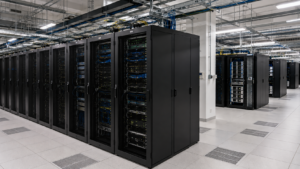
Most people imagine tanks, drones, and missiles when they think of modern warfare. But the real decision-making takes place within data centers. These types of buildings are where intelligence is processed, and AI models are run. They provide the insights that guide every decision on the battlefield. So, data centers in modern warfare become high-value targets rather than background systems. They don’t just hold data. They power targeting, coordination, and response. And governments spend a lot of money on this level. Speed and accuracy are what determine the results now. If you want to understand how wars are fought today, you really need to know how data centers underpin warfare from behind the scenes.
Data Centers: Digital Backbone of Military Decision Systems
Modern warfare depends on speed. Data centers in modern warfare create that speed by turning raw inputs into decisions within seconds.
Real-Time Intelligence Processing Pipelines
Military equipment is producing vast amounts of data every second. Satellites take pictures. Drones provide live video streams. Sensors capture signals. All of this is processed by data centers on the modern battlefield, instantly. They filter out the noise and bring critical patterns to light. For instance, feeds from ISR drones are routed through real-time analytics that detect movement and alert to potential threats. These pipelines are typically designed by engineers using distributed compute clusters. They partition the workloads between nodes to keep the system responsive. The result is that the commander on the ground gets a clean, prioritized intelligence. So they don’t waste their time scrolling through raw feeds. Hence, the increase in processing speed when it comes to Data centers in modern warfare directly translates into improved mission timing and accuracy of the strike.
AI Model Hosting for Threat Detection
AI models run within high-performance environments. These models are housed in data centers in modern warfare and are constantly analyzed. For instance, image recognition programs run over satellite images to find vehicle movement or structural shifts. Signal intelligence models monitor for anomalous communication patterns. These are models that need to be updated on an ongoing basis. Data centers hold the compute and storage needed for retraining. The teams roll out new models fast and maintain an accurate system, so detection becomes reactive to predictive. So now operators have to rely on AI outputs in order to move faster. So what you have is AI and data centers in modern warfare as a single system.
Latency and Proximity in Tactical Advantage
Distance slows decision-making. In modern warfare, data centers minimize this lag by proximity to operations. Teams place edge nodes in or near conflict zones. These nodes locally process the data. For instance, forward troops are now able to analyze drone video on the ground rather than shipping it off to far-flung hubs. It saves so much time from having to wait around. Edge systems also operate in unreliable networks. They are able to function even when the connections fail. As a result, a mission is not dependent upon a single central system. So speed and reliability are two things proximity gives you in “real” gameplay.
Data Fusion Across Multi-Domain Operations
Today’s warfare encompasses land, air, sea, cyber , and space. Each domain has different data. Modern warfare data centers bring these inputs together into a single view. They convert formats and synchronize timelines. For instance, systems integrate satellite imagery, radar tracking, and cyber intelligence feeds. It’s a unified operational picture. Commanders receive context, not isolated signals. So you’re seeing multi-domain teams that are coordinating more rapidly. They can answer with greater precision. So fusion of data eliminates confusion and enhances clarity of decision-making.
Data Centers in Modern Warfare: Infrastructure Resilience Under Conflict Conditions
Military systems must remain functional under pressure. Data center design focuses on maintaining operations during disruption, not just during normal conditions.
Redundancy Architecture and Failover Systems
Military infrastructure is designed to avoid single points of failure by using load balancing among multiple active sites. Rather than depend on backup systems, engineers operate parallel systems that continually share the load. When an environment fails, others take on the work immediately. Such distributed systems, such as distributed defense cloud systems, keep mirrored environments in multiple regions. These environments are constantly performing data synchronization to ensure that no gaps occur. Automation-based orchestration systems detect failure states and migrate workloads in real-time. This process of data centers in modern warfare minimizes downtime and maintains continuity during intentional interruptions or unanticipated disruptions.
Cyber Defense Layers Protecting Military Data
Military information is subject to constant cyberattacks by state and non-state actors. Data centers use layered defense models to compartmentalize systems and limit lateral movement within networks. For instance, zero-trust models mandate verification at all access points, and behavioral analytics solutions scan traffic for anomalous behavior. When systems detect abnormal behavior, containment processes are triggered to prevent spread. This involves isolating breached segments and rerouting traffic. They work proactively, as opposed to reactively, when an incident does occur. This active defense model minimizes risk and supports the continuity of operations throughout cyber conflicts.
Physical Hardening and Location Strategy
Infrastructure protection is not confined to the digital systems. Physical security is crucial to the continuity of operation. Military planners choose sites according to risk, vulnerability, and importance. Complexes typically feature reinforced buildings, high security door systems, and environmental controls. Indeed, some facilities work in isolated – if not classified – areas. Some also feature underground buildings to mitigate exposure to the elements. A further risk mitigation is to spread the facilities out among multiple sites. This step-down approach ensures that the integrity of the overall system performance is not compromised by any physical threat.
Continuity Planning During Active Conflict
The operational environment evolves quickly in the midst of war. Systems should change adapt without mission flow interruption. Through dynamic workload management and predefined response plans, data centers in modern warfare enable this. Orchestration platforms, for instance, track the health of the system and reroute workloads if interruptions are detected. Teams also equip alternative communication routes and backup infrastructures prior to their deployments. Routine simulation exercises evaluate these changes through simulation. This readiness ensures a predictable response of systems in actual incidents. It also enables teams to remain consistent in their operations while suddenly changing conditions force them to adapt.
Strategic Control, Sovereignty, and Global Power
Control over digital infrastructure now influences geopolitical strength. Data centers in modern warfare play a direct role in shaping national capability.
National Data Sovereignty and Military Control
Governments impose tight regulations on the location of sensitive data and the manner in which systems handle it. Military workloads often remain in the national infrastructure to minimize dependencies on outside sources. This strategy helps avoid foreign laws and the risk of interception. For instance, classified systems run in secured closed domestic environments and have strictly limited access. These systems have very strict authentication and monitoring requirements. This control is so that governments keep control of the critical operations. It also reduces vulnerability at the time of geopolitical tensions.
Big Tech Partnerships with Defense Systems
Military firms work with private sector suppliers to scale infrastructure effectively. Commercial platforms have more advanced capabilities that speed up deployment and enhance performance. The U.S. Department of Defense and other agencies partner with technology providers to create systems that are both flexible and scalable. These partnerships twofold the innovation with the security requirements that are needed. Defense cloud programs, for example, combine commercial infrastructure with bespoke security layers. This architecture enables more rapid upgrades and wider capacity without having to build everything from the ground up.
Data Centers as Targets in Hybrid Warfare
Contemporary warfare is infused with unconventional methods that focus on infrastructure rather than face-to-face combat. Data centers in modern warfare are high-value targets because they house communication, intelligence, and coordination systems. Opponents seek to interfere with operations by cyber attack, by overwhelming the system, or by other means. Coordinated attacks, for instance, could strain network resources or hinder access to essential services. These activities produce operational delays in the absence of physical conflict. Protecting infrastructure, therefore, becomes part of a defensive strategy. It also needs continuous monitoring/rapid response capabilities.
Global Competition for Strategic Infrastructure
Nations pour resources into digital infrastructure to reinforce long-term capabilities. Data centers enable the development of AI, intelligence, and mission coordination. Countries increase their capacity to reduce dependency on foreign providers and become more self-reliant. For example, governments are investing in hyperscale facilities and regional hubs around future workloads. This competition goes beyond economic growth. It has implications for military readiness and technological leadership. So, infrastructure development becomes a major player in global power politics.
To Sum Up
Today, data centers in modern warfare dictate the tempo. They run intelligence and AI systems. They keep it together under pressure. And most dramatically, they shape national security and global power. So indeed, there is a clear advantage in understanding this infrastructure. For a more in-depth understanding of real problems – AI workloads, Infrastructure scaling, deployment strategies – take a look at the 6th High-Density AI Data Center Infrastructure Summit – Ashburn, VA (May 27-28, 2026). The program includes discussions around power, cooling, connectivity, and rapid capacity delivery. Learn more!