

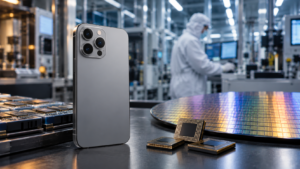


AI companies are hitting a limit with traditional processor design. Bigger GPUs just aren’t enough anymore. Modern AI models transfer huge amounts of data every second. That puts strain on memory, bandwidth, cooling, and power delivery in entire AI data centers.
A few years ago, semiconductor firms were more focused on shrinking transistor sizes. That policy boosted performance for decades. Now the situation looks very different. Advanced AI workloads require speedier communication between processors, memory, and accelerators. As a result, the architecture of AI chips is evolving rapidly in the US.
This change of focus explains why UCIe is now capturing the attention of the bulk of the semiconductor industry. Rather than squeezing every function into a single monolithic processor, they can build modular systems using smaller chiplets that are interconnected within a single package. UCIe enables that communication across a standard chiplet interconnect.
Today’s next-generation AI chip builders are as focused on flexibility as they are on raw performance. They also want to reduce the costs of manufacturing and to speed up product development. Hence, UCIe is emerging as one of the critical technologies underpinning the future AI semiconductor infrastructure.
Why AI Infrastructure Needs a Different Design Approach
Traditional chip design performed well when workloads were much simpler. The bulk of processors were executing predictable computing workloads. AI workloads turned that on its head.
Training a large language model involves the movement of a lot of data between GPUs and memory systems, constantly. A processor may perform trillions of operations, but if memory can’t keep up, performance drops. In many AI accelerator chips, bandwidth constraints throttle a system more than compute power itself.
Consider an AI training cluster, for example. Tens of thousands of GPUs are collaborating on model training. Each processor continuously communicates with other machines that are local. Even minimal latency in communication degrades performance throughout the infrastructure.
In the meantime, it has grown increasingly more difficult to mass-produce larger processors.
Advanced semiconductor nodes like 3nm and 2nm take incredible amounts of money to make. Large monolithic dies also have lower yields. A single tiny manufacturing defect can ruin an entire chip. That means more waste and much higher production costs.
Heat creates another major problem.
Highbandwidth AI chips use huge amounts of energy when running training workloads. Some—but not all—AI DC chips now need to be liquid-cooled since air cooling is becoming inadequate for the heat density. Larger dies tend to focus heat into smaller regions. That makes the cooling systems more difficult to control.
Meanwhile, Moore’s Law isn’t producing the same leaps in performance that the industry expected. Semiconductor firms are continuing to increase transistor density, but the benefits of scaling are diminishing. As a result, organizations began to look outside of traditional processor design.
That shift pushed the industry toward heterogeneous chip design.
Rather than a single giant processor, chip makers now divvy up functions into specialized chiplets. One die might be dedicated to computing. Another may be responsible for memory access. Additional dies may handle networking or I/O functions.
It gives manufacturing a lot more breathing room. Smaller dies are more easily produced successfully. Companies also have the option of upgrading individual chiplets, rather than redesigning a whole processor from the ground up.
But modular systems pose a different problem. Well, all of these chiplets have to communicate extremely fast, at ultra-low latency, while being power efficient. That need made UCIe chip architecture-fabric for modern AI systems all the more vital.
How UCIe Is Driving the Chiplet Ecosystem Forward
UCIe stands for Universal Chiplet Interconnect Express. The idea behind it is actually straightforward.
It creates a common communication layer for chiplets inside advanced semiconductor packages.
Earlier, semiconductor companies mostly relied on proprietary die-to-die interconnect systems. Those technologies worked within closed ecosystems, but compatibility remained limited. Different vendors could not easily integrate chiplets.
UCIe changes that model completely.
It’s like comparing it to USB in consumer electronics. USB enabled different manufacturers’ products to interconnect using a single standard form. UCIe does much the same thing for semiconductor chiplets.
That flexibility is important as AI workloads get more specialized every year.
Say one company cares more about memory bandwidth for generative AI training. Another may be more interested in power efficiency for edge AI deployments. Some cloud providers may want stronger networking for huge AI clusters.
UCIe allows companies to mix different chiplets based on workload needs.
A processor package could combine:
- compute dies,
- HBM memory stacks,
- AI accelerator chips,
- networking chiplets,
- & custom AI silicon
inside one system.
This approach improves development speed because manufacturers no longer need to redesign every processor from the ground up.
It also improves manufacturing economics.
Think of manufacturing one massive processor that includes everything. If any part fails during production, the whole chip is rendered useless. Now imagine taking that design and breaking it into smaller chiplets. When a chiplet fails, they don’t need to replace the entire multichip module (MCM), but instead they just swap out the failing chiplet, saving a lot of cost.
They greatly improve yield.
Sophisticated chip packaging is also critical in that.
Techniques like 2.5D packaging and 3D stacking bring chiplets into tight proximity. Latency is reduced, and bandwidth across the package is improved. Semiconductors for AI workloads are now being packaged using these techniques.
HBM memory shows why this matters.
AI models constantly move huge amounts of data between processors and memory systems. Keeping memory physically closer to the compute dies improves performance dramatically. UCIe helps support these high-speed chiplet connections efficiently.
That is why semiconductor packaging trends in the USA are evolving so rapidly.
Companies such as Intel, AMD, NVIDIA, and large hyperscalers are pouring significant sums into modular AI infrastructure. They want shorter development cycles, lower production costs, and more flexible hardware ecosystems.
At the same time, cloud providers want processors tailored to their workloads. Designing full custom processors all the time takes too long and costs too much. UCIe makes modular customization that much more feasible.
As a result, the chiplet ecosystem is expanding at a rapid pace within the semiconductor industry.
Why UCIe Could Shape the Future of AI Infrastructure
AI infrastructure will likely be far more modular within 10 years.
Companies will need to move away from fixed processor designs towards configurable systems made up from interchangeable chiplets. Different-informed workloads will call for different hardware solutions. Some systems may be optimized for inference efficiency. Others may be dedicated purely to AI training bandwidth.
UCIe makes that flexibility possible.
The technology may also become critical for future optical communication systems.
Currently, transporting data over copper interconnects uses a lot of energy. The demands for power are rising as the AI infrastructure grows. That’s why semiconductor companies are pouring money into silicon photonics and optical I/O technologies.
Optical communication is much faster and much cooler. But optically interfacing systems on chips need flexible modular architectures, which haven’t been developed yet. UCIe facilitates building that baseline.
The technology could also lower barriers for semiconductor startups.
Smaller companies may no longer need to build complete processors independently. Instead, they could specialize in individual chiplets & integrate them into larger ecosystems. That can speed up innovation across the U.S. semiconductor industry.
Still, challenges remain.
Thermal management is more challenging in high-density packaging. Testing complex chiplet systems also requires advanced validation techniques. Security concerns could escalate, since interconnected dies result in larger attack surfaces.
The supply of packaging is another matter of concern. The United States advanced packaging infrastructure still has to be scaled up dramatically to meet growing AI demand.
Momentum for UCIe is building rapidly, despite these hurdles. AI growth is now driven by a lot more than raw compute power. Memory bandwidth, packaging efficiency, and interconnect speed are all becoming critical.
To sum up
UCIe is becoming a core technology behind future AI chip architecture and advanced semiconductor infrastructure. Companies investing in chiplets, advanced packaging, and modular AI systems will likely shape the next generation of AI computing in the United States. If you want deeper insight into semiconductor packaging, AI infrastructure, and future fab development, the 7th U.S. Semiconductor Fab Design, Engineering & Construction Summit will take place in Washington, DC, on 24–25 June 2026. The event will bring together semiconductor leaders, infrastructure experts, and advanced packaging specialists from across the industry