



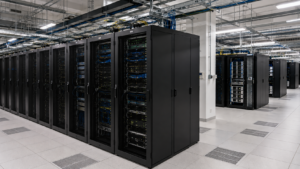
Artificial intelligence now underpins one of the largest infrastructure transitions in contemporary business. Firms from banking, healthcare, retail, logistics, and software are clamoring for AI tools that help them move faster, spend less, and make more money. But many executives still don’t know the fundamental difference between platforms that build AI models and platforms that run AI for customers.
That discrepancy causes costly errors in planning, budgeting, and implementation. Some companies buy too many computers and waste money. Others trade off latency for user experience. Thus, the separation between training environments and inference data centers must be understood now. This guide covers architecture, cost, site strategy, hardware, cooling, security, and where the US market is heading next.
What Are Inference Data Centers? Full Definition, Role, and Why They Matter
Inference data centers run trained AI models in real time. They handle live queries from end users, software platforms, and business applications. Every response from a chatbot, fraud alert, recommendation outcome, translated message, and answer from an AI search is driven by inference capacity.
In contrast to research settings, these facilities are geared toward production delivery. So, speed, uptime, scalability, and a predictable operating cost are the most important factors.
Why Inference Data Centers Are Growing Faster
A lot of companies don’t train their own models. They license models or use APIs. But they still need infrastructure to run those models. So, the demand for inference data centers can be spread out across thousands of companies, not just a handful of big AI labs.
Common Business Uses of Inference Data Centers
- Customer support bots
- AI search & recommendations
- Fraud detection systems
- Voice assistants
- Coding copilots
- Workflow automation
- Predictive analytics
As a result, inference has become the commercial side of AI adoption.
What Are Training Data Centers? How AI Models Are Built at Scale
Training data centers build or enhance AI models via iterative, massive-scale computation. Engineers input text, images, code, or sensor data into systems. Next, the model learns patterns by changing internal parameters iteratively.
This can take up to days or weeks, depending on the size of the model and the availability of hardware.
Core Priorities of Training Data Centers
Training environments require maximum computation performance. They require high-bandwidth communication between chips, as well. If there are communication bottlenecks, training time goes through the roof.
Therefore, operators prioritize:
- Dense compute halls
- High-bandwidth networking
- Massive storage pipelines
- Strong redundancy
- Stable thermal control
- Expansion-ready campuses
Why Only Some Companies Need Training Capacity
The majority of enterprises don’t have the need to build frontier models. They need outcomes, not mode ownership. As a result, training is bypassed, and investment is focused on inference data centers in many organizations.
The Most Important Differences Explained: Training vs Inference Data Centers
Training & inference may use similar chips, but their business purposes are quite different.
Training Builds Intelligence
The training part synthesizes the model. Through repetitive computation, it enhances the precision, thinking, & ability.
Inference Delivers Intelligence
Inference data centers utilize completed models to serve up real requests with speed and dependability.
Why This Difference Matters Financially
Training can require massive capital investment before returns are realized. Inference is typically connected more quickly to measurable business value, such as reductions in support costs or increases in sales conversion. Therefore, a good number of CFOs sign off on projects for inference before the large training jobs.
Inference Data Centers Architecture: How Production AI Facilities Are Designed
Strong inference data center design balances speed, resilience, & cost control.
Front-End Request Layer
This layer receives prompts, API calls, or application requests. It routes traffic to compute nodes that are available.
Model Serving Layer
This layer hosts AI models and manages token generation, scoring, ranking, or prediction tasks.
Data Layer
It stores prompts, logs, vector databases, usage history, & security records.
Orchestration Layer
This layer balances traffic across nodes/regions. So, if one zone fails, traffic shifts elsewhere.
Therefore, architecture must support growth without meddling with user experience.
Hardware Used in Inference Data Centers vs Training Data Centers
Training is frequently reliant on tightly coupled GPU clusters since multiple accelerators need to work in unison throughout model training. But the hardware approach can be more flexible in inference data centers.
Common Inference Hardware Options
- GPUs for demanding language models
- CPUs for lightweight models
- ASIC accelerators for efficiency
- Mixed clusters for cost optimization
Why Hardware Choice Matters
The best training chip may not be the best inference chip. In production, cost per query often matters more than peak benchmark speed.
Data Center Power Demand for AI Workloads in the USA
AI has made data center power one of the most critical constraints in the market.
Why Training Uses So Much Power
Training runs dense hardware at high utilization for long periods. Large campuses may need major utility upgrades.
Why Inference Also Creates Huge Demand
One site may use less than a mega training campus. However, many distributed inference data centers together can consume enormous amounts of electricity.
Questions Buyers Must Ask
- How soon can power be delivered?
- What are future electricity rates?
- Is backup generation available?
- Can renewable energy be added?
Therefore, energy access now drives location strategy.
Liquid Cooling Data Center Trends for AI Racks
Traditional air cooling struggles with dense AI hardware. As rack power rises, thermal pressure rises too.
Why Liquid Cooling Is Growing
A liquid cooling data center conducts heat removal at the chip level. This may enable greater efficiency and higher rack densities.
Where It Is Used First
Training sites often adopt liquid cooling earlier. Yet, inference data centers are also moving this way as production clusters grow more powerful.
What Operators Must Evaluate
- Water management
- Leak controls
- Retrofit costs
- Technician training
- Maintenance planning
Why Low Latency AI Requires Regional Inference Data Centers
Speed matters in production AI. Users expect responses almost instantly.
Examples Where Delay Hurts Revenue
- Slow chat support lowers satisfaction
- Delayed fraud checks slow payments
- Lagging search reduces conversions
- Voice delay harms usability
Therefore, low-latency AI depends on placing infrastructure near demand centers.
Best US Markets for Regional Inference Capacity
- Northern Virginia
- Dallas
- Chicago
- Atlanta
- Phoenix
- Los Angeles
That is why many operators expand inference data centers near major metros.
Why Ashburn Data Centers Remain Critical for AI Growth
Northern Virginia remains one of the most connected digital markets in the world.
Advantages of Ashburn
- Dense fiber routes
- Strong cloud presence
- Mature vendor ecosystem
- Skilled labor pool
- Large enterprise demand
Because of this, Ashburn data centers continue to attract cloud & AI workloads.
Emerging Challenge
Land and power pressure are rising. Therefore, nearby regions may absorb overflow growth.
Hyperscale Data Centers vs Distributed Inference Data Centers
Large model developers still rely on hyperscale data centers for centralized training. These sites gain economies of scale. However, distributed inference data centers often provide a better user experience.
Hybrid Strategy Used by Many Enterprises
- Centralized training hubs
- Regional inference zones
- Backup failover sites
- Local edge nodes
This model balances cost, resilience, and latency.
Security and Compliance in Inference Data Centers
Inference often handles live customer data. That creates stricter requirements than many training environments.
Critical Controls
- Encryption
- Identity management
- Audit logs
- API security
- Access segmentation
- Incident response plans
Therefore, regulated sectors may prefer private deployments or edge AI infrastructure.
AI Data Centers USA Market Outlook Through 2030
The United States combines capital markets, enterprise demand, engineering talent, and strong networks. Therefore, AI data centers in the USA should remain strong in growth.
Markets Likely to Benefit
- Virginia for connectivity
- Texas for expansion scale
- Midwest for land and power routes
- Southwest for growth corridors
- Southeast for metro demand
What Investors Are Watching
- Power-ready land
- Fast construction timelines
- Cooling innovation
- Carrier density
- Colocation demand
How to Choose Between Training and Inference Infrastructure
If your company needs custom foundation models, training may justify the spend. If your company needs business outcomes now, inference data centers may offer faster returns.
Practical Decision Questions
- Do we need to own the model?
- How important is response speed?
- What is the expected user volume?
- What compliance rules apply?
- Can we secure power capacity?
- Is ROI tied to usage growth?
The answers guide the right mix.
To Sum Up: Why Inference Data Centers May Drive the Next AI Boom
Training sites develop sophisticated AI models, but inference data centers monetize those models on a daily basis for enterprises and consumers. They power chatbots, search, fraud checks, assistants, and enterprise automation at scale. So, they could lead to more general market growth than training campuses since virtually all industries could make use of them. The companies that get the latency, the power, the cooling, and the site strategy will have an advantage.
For expert insight on infrastructure delivery, power readiness, cooling systems, modular expansion, and future capacity planning, join us at the 7th Data Center Design, Engineering & Construction Summit – Ashburn, VA, USA – May 27-28, 2026, and network with the leaders of the next generation of digital infrastructure.